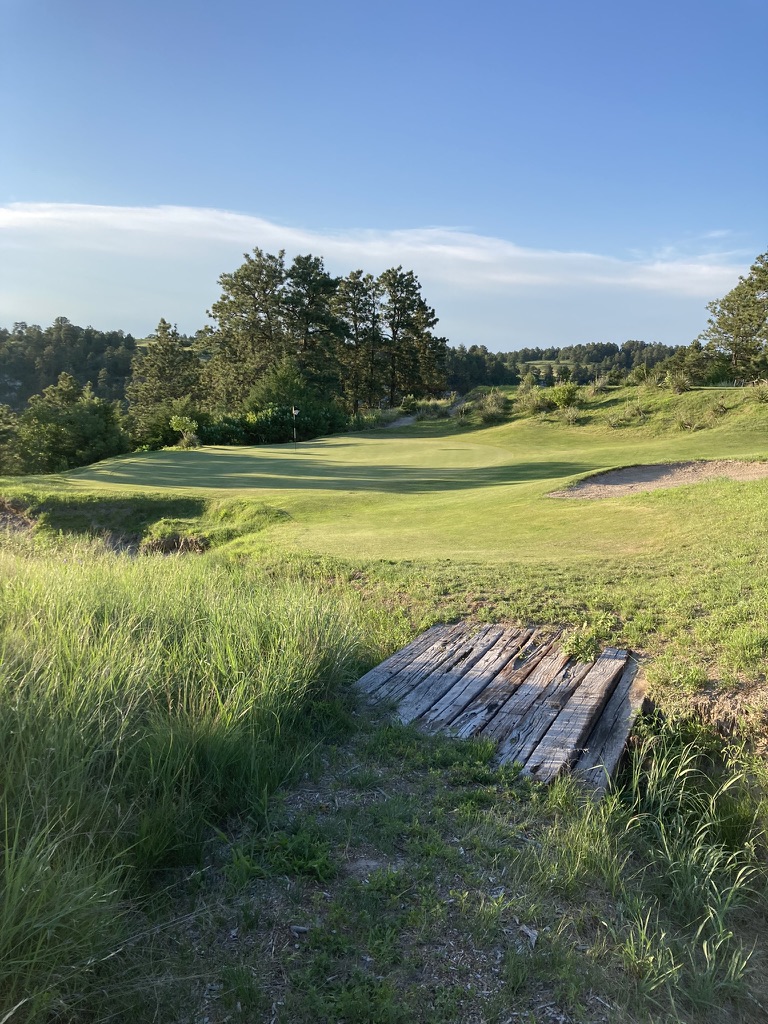
Growing up, our house was on a quarter acre suburban lot and I spent hours hitting waffle balls from corner to corner to corner, around trees, over the fence, off the roof, and down the sidewalk. Dozens of routes to green sites that only I could see. Each hole was made up as I went along; a loop that stopped when it either got dark or I lost all the balls. Long grass, pine bushes, and flowerbeds provided a puzzle that I solved as I found it. Any time I play a short course, I’m chasing that feeling. The best evoke that playfulness.
These three shorties each embody a different target at a different type of golf course. The semi-private Prairie Club’s Horse Course has ten full, distinct golf holes that unveil themselves as you go. Fully public Wild Horse has the Pony, a quick five hole loop and good preparation for the full round with greens and shots that mirror some of what’s to come. Fully private Lost Rail’s Track Iron Seven is a good wind down after the round with friends or a couple loops on a lazy evening. Each one has its purpose and none of them ask you to take things too seriously.
The Horse Course
Architects: Gil Hanse and Geoff Shackelford
Highlighted holes: 1, 2, 3, 4, 5, 9

Named after the schoolyard basketball game, the ten hole course was an early adopter of the winner of the previous hole chooses the next box design. Its layout allows for running shots using contours to get close but also welcomes a touch wedge. Most golfers won’t need more than a couple clubs and their putter.
It was built by Gil Hanse and Geoff Shackelford, the partnership that brought us Rustic Canyon, a highly regarded public course near Los Angeles, and the restoration/renovation of LACC North ahead of the 2023 U.S. Open. It was around this time that Hanse had been working on his own routing at the Prairie Club, one that prominently used the canyon’s edge and would end up opening more than fifteen years later as CapRock Ranch.
The true magic of the horse course is the feeling that you’re discovering something as you play.
One: Perched on a ridge, the first hole is all about distance control to a hilltop green. Short shots will slide back down into a valley. Pins on the left side hide behind a yucca plant and a charming little bunker. A large bunker long and right is ready to eat anything too wayward. The first is an exercise in distance control.

Two: Rolling fairway that looks like the sixth at Royal North Devon in miniature stands between tee and green. Take it as a challenge to hit a low punch and watch as it appears and disappears on its way toward a green shared with seven. Two’s half of the green is a little smaller with a saucer at front right and a fall off left side. A bunker that you might not notice occupies the middle of the green and can catch anything hit too firmly.


Three: The third has the kind of slope that you can get away with on a short course. Make it twice as big and it’d look right at home on the Mulligan Course at Ballyneal. There’s a high side and a low side. You’ll want the ball to stay with a pin up top and go with a pin down low.


Four: The fourth is inevitably the postcard hole at the Horse course and in contention with the Dunes’ fourth for the whole club. It’s tucked in a basin up against the snake river canyon. Its bunkers and yucca and bushes are all meticulously placed. Be sure to savor the hike down from the tee and if it’s a quiet night, stand along the canyon and be glad you’re there.


Five: The fifth is the hole that reminds me most of the course in my yard. The tee is up from the fourth green, over a rather large bunker to a skinny, blind green. You can see the top of the flag, but that’s about it. It’s confounding the first go ’round and a delight on the second. The miss here is just left of the green where the slope will work your ball back down towards the pin.


Nine: The ninth has the best hike on the course. Carry the trees and shrubs and the winding bunker to an undulating green. Then make the trek through the wilderness and up a set of stairs in the slope to see what comes next. A bunker hides within the rough on the back left side.


The Pony
Architects: Dave Axland and Dan Proctor
Highlighted Holes: Yellow, White, Green, Blue, Red

Wild Horse wisely brought Axland and Proctor back to build their short course. The Pony is tucked in the valley between the driving range and tenth hole. It’s free for kids and $10 for adults: a bargain if you think about the cost per hole. The equivalent price for an eighteen hole course is $36; more than reasonable.

The greens are the focus and the highlight with contours that play big. Like on the main course, they’re built for the speed of modern greens but tie in the playfulness and options of links courses. The surrounds are full of subtlety with bumps and slopes. They’re good practice for what you’ll find when you play eighteen.
Unconventionally, the holes don’t go 1 through 5. Each one is assigned a color that corresponds with the color of its flag. Each hole has a beginner tee and an advanced tee, identified by either a solo pony marker or a marker and a skull.
Yellow: There is nothing but grass between the tee and the green inviting you to run the ball up. It can be played off the high right side and brought down to the pin. Anything out to the left will take a tricky pitch or bump and run to get back to the pin. While it wasn’t there the day I played it, I believe this green can fit a second pin for an additional sixth black hole.


White: The white can be pushed back to 170 yards making it the longest on the course. Its advanced tee sits behind the first green for an elevated tee shot that needs to be carried over the native. A large round mound in front of the green will repel shots hit short or, if you’re lucky, propel them onto the green. If you are short, you face a bump and run up the hill to the skinny green. Long misses will likely end up in one of the Bunker Hill Boys’ signature hazards. Tucked into the end of the course, the white hole nestles up against a grove of trees and feels like it was always meant to be there.


Green: Like a taco mid-fold, the green hole rises on both sides with a low point in the middle. It has a prominent back tier, false front, and delightfully small front shelf that drops off quickly down into the fringe. The transition from the green hole to the blue is a little bit of a hike, but I thought it was fine and I saw a snake so that was cool.


Blue: The blue offers a tempting opportunity to try and run another shot in but a steep falloff to the right demands precision without guarantees. It’s a short little demonstration of the high-low strategy that the duo used on the fourth hole at Bayside. The green has a sharp wing at the back that can be used to bring chips down to the hole or keep hot shots on the surface.


Red: The red and final hole is backed by Wild Horse’s signature bushes from the eighteenth. The front bunker is deceptive and sits farther away from the green than expected. A ridge comes off the green on the left and shows more incredible craftsmanship. Misses right will fall down into either a bunker or leave one of the longest recovery shots on the course. One could spend a lot of time out here trying an array of shots.


A set of greens like this make me continue to scratch my head and wonder why Axland and Proctor didn’t get more opportunities on their own. Wild Horse and the Pony are as good a main and short course combo as you’ll find in public golf.
Track Iron Seven
Architect: Scott Hoffman

It’s not all Horse and Pony show. Lost Rail’s short course is snuck in along the property line on the far west side of the course. Named for The Track Iron, a precursor to the wedge that was often used to extricate oneself from the kinds of trouble 19th century conditioning created, the short course has four greens, the first three with two pins and the last with one. Hole locations on each can be set on a perch or in spots where the ball can be worked toward them.
Each green is longer than it is wide and I imagine the concept might not work as well in a public setting with many golfers hitting towards each other. For Lost Rail, it’s a perfect compliment to the big course and rarely busy. It’s the kind of course you could regularly spend an hour hitting all kinds of shots on playing up and down the strip of land. In this case, I’ll let the photos speak for themselves.
First Green:


Second Green:


Third Green:


Fourth Green:


Leave a comment